AI models can speed up the simulation of materials at the atomistic scale. However, the models’ approximation introduces uncertainty that biases the results. We developed a method, PEM, to adapt the Monte Carlo algorithm and penalize regions that are uncertain for the AI, mitigating AI errors and making deep learning-based materials modeling trustworthy.
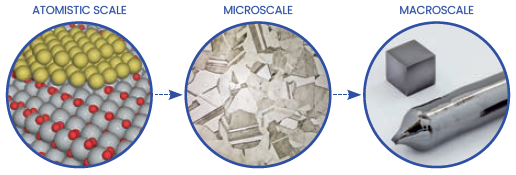
In our research on complex materials, we used multi-scale approaches that establish a relationship between a material’s atomistic behavior and macroscale properties. The goal is to bridge the gap between the atomistic scale, which is governed by interatomic forces, and the macroscale, with a view to modeling materials and their defects accurately.
Molecular dynamics, Monte Carlo sampling, and other simulation methods remain essential. However, because they require repeated and precise total energy and force calculations, they quickly reach their limits for the modeling of large or complex systems. Researchers use deep learning models—machine learning potentials (MLP)—as surrogate functions to get around the high computational cost of the simulation methods mentioned above.
Multi-scale modeling of materials.
These neural networks effectively replace high-fidelity physical calculations by efficiently approximating potential energy surfaces or force fields. This significantly speeds up atomistic simulations, creating new possibilities for the exploration of a wider range of configurations.
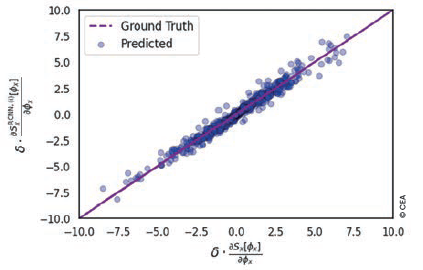
Fig. 1 : Microscale energy predicted as a function of a precise calculation of energy. The AI’s excellent prediction performance is worth noting.
However, the increase in speed creates a new challenge around trustworthy AI. Because they are approximations, MLPs inherently come with errors like epistemic uncertainty, which increases when the model is faced with configurations that have been encountered little or not at all during training. Our research revealed that this energy Trustworthy, safe AI Artificial intelligence technologies uncertainty can distort predictions of macroscopic physical properties. The most important finding from this research is that, if this uncertainty is to be recognized and actively managed, adaptations must be made to the simulation algorithm itself.
We developed the Penalty Ensemble Method (PEM) to quantify this uncertainty and integrate it directly into the Monte Carlo simulation. The standard Metropolis-Hastings acceptance rule that MC-MC is based on determines whether a proposed configuration is accepted or rejected. PEM factors in uncertainty to modify the rule. This increases the probability of rejection for configurations located in regions where MLP exhibits high predictive uncertainty.
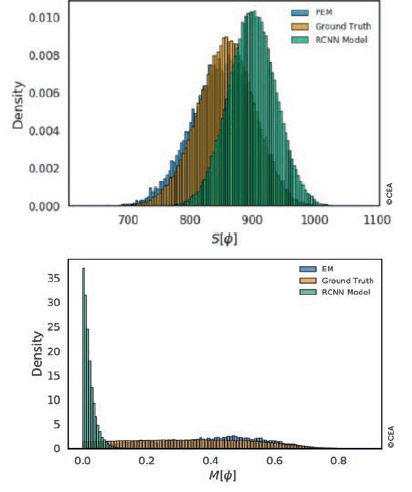
Fig. 2 : Monte Carlo simulation results. Despite the AI models’ excellent performance, significant bias between precise and costly simulation (orange – Ground Truth) and AI-guided simulation (green – RCNN) was observed. The AI-guided simulation can be corrected using the PEM method (blue).
By penalizing displacements toward uncertain regions, PEM mitigates the bias introduced by the MLP error, making the simulations more reliable and consistent. Despite the use of an approximate model, the properties obtained are close to the reference values.
We demonstrated that using PEM to integrate uncertainty quantification provides a solid path toward combining the speed advantages of deep learning with the physical precision of Monte Carlo simulations. This advance paves the way toward robust, reliable materials modeling to meet the needs of critical industries.
Learn more
Flagship publication
“The PEM method” was developed in 2025 as part of Dimitrios Tzivrailis’ PhD research with Alberto Rosso, Research Director at the Laboratoire de Physique Théorique et Modèles
Statistiques (LPTMS, CNRS). (https://doi.org/10.48550/arXiv.2506.14594)
Major project
Tzivrailis’ PhD research is funded by the PRIMaL (Probabilistic Reasoning in Machine Learning) project to extend the operational domain of AI by providing usability guarantees for deep learning models. One of PRIMaL’s primary objectives is the quantification of uncertainty: calculating and controlling uncertainties (both random and epistemic) to make AI a reliable scientific calculation tool.
Application
PRIMaL is part of our research on trustworthy AI, essential for critical use cases like materials modeling and simulation-based inference (SBI).
Contributors to this article
Eiji Kawasaki, Research Engineer and Expert, CEA-List
Dimitrios Tzivrailis, PhD student, CEA-List
Le CEA est un acteur majeur de la recherche, au service de l'État, de l'économie et des
citoyens. Il apporte des solutions concrètes à leurs besoins dans quatre domaines
principaux : transition énergétique, transition numérique, technologies pour la médecine
du futur, défense et sécurité.