

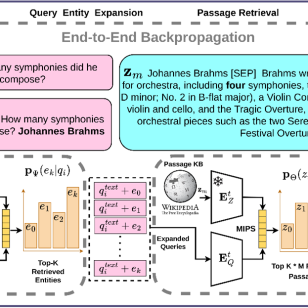
CEA-List developed the MiRAG model for visual question answering about named entities. This is the first time a retrieval augmented generation (RAG)-based approach to generative AI has been applied to this task.
Read more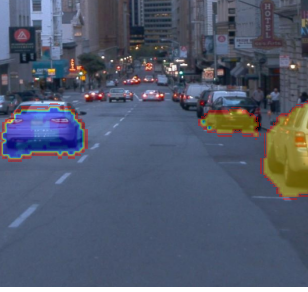
xMOD combines 2D vision (cameras) and 3D vision (LiDAR sensors) in a novel cross-distillation method. The AI learns to segment its environment from motion cues in the images, delivering beyond state-of-the-art performance.
Read more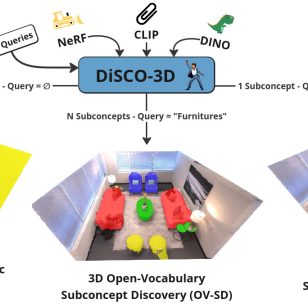
The DiSCO-3D semantic segmentation method is used to discover, in a 3D scene, the elements corresponding to the semantic subconcepts of a user query expressed in natural language.
Read more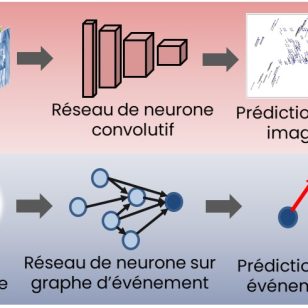
Event-driven cameras provide low-latency motion detection. Our method leverages asynchronous event graphs that take full advantage of the cameras’ high time resolution to detect motion with very low latency (just 50 milliseconds) while reducing the number of operations 48-fold compared to the state of the art.
Read more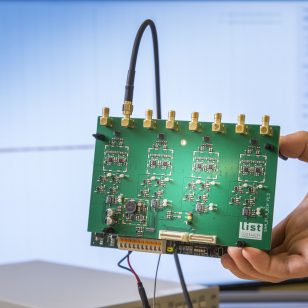
Advances in Edge computing and AI have made integrating analysis capabilities directly into acquisition systems a reality.
Read more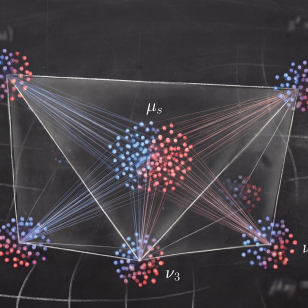
CEA-List developed De-FedDaDiL, a fully distributed method for multi-source domain adaptation (MSDA).
Read more
CEA-List developed federated learning algorithms to predict charging station occupancy in real time without sharing sensitive user data.
Read more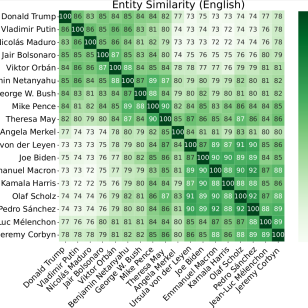
CEA-List developed a new method for measuring political bias in large language models.
Read more