


We studied a C22E/C22R-grade structural steel sample with a minimum cross-section of 7.6 mm and a gauge of 12 mm. We applied a cyclical load of 230 MPa at a frequency of up to 5 Hz until failure. To monitor variations
in magnetic permeability, eddy-current measurements were taken at different excitation frequencies (50 kHz, 100 kHz, 250 kHz, and 500 kHz).
A semi-analytical model was used to solve the direct problem: the calculation of impedance as a function of magnetic permeability. The experimental results were compared to simulations to validate the model. The material’s relative permeability, μ, was estimated in the range 150-180, with permeability decreasing as a function of time over the course of the experiment.
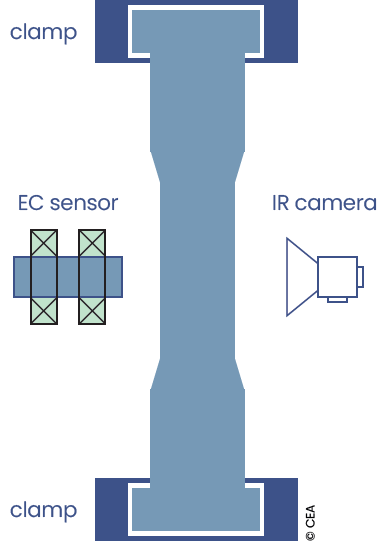
We also took magnetic Barkhausen noise (MBN) measurements to round out the eddy-current measurements. Thermographic data was used for correlation. We also factored in temperature variations to correct for any drift caused by the sample heating up.
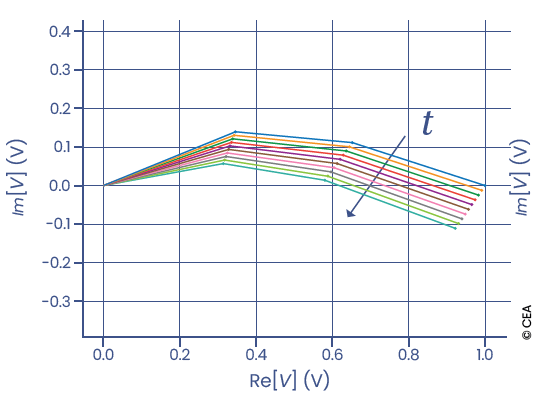
Now that eddy-current measurements have been demonstrated on the monitoring of fatigue-induced degradation, the door is open to new industrial solutions for real-time monitoring to help improve the safety and durability of metal structures.