

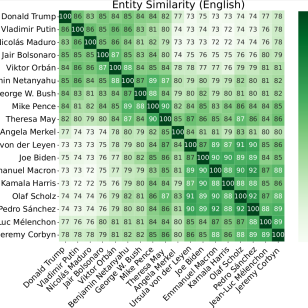
CEA-List developed a new method for measuring political bias in large language models.
Read more
The formal verification of neural networks presents many challenges. Although there are languages to describe how a neural network is expected to behave, current validation tools do not consider the full richness of these languages. CEA-List is investigating practices from the field of programming languages to expand the scope of what can be formally verified.
Read more
We developed a method, PEM, to adapt the Monte Carlo algorithm and penalize regions that are uncertain for the AI, mitigating AI errors and making deep-learning-based materials modeling trustworthy.
Read more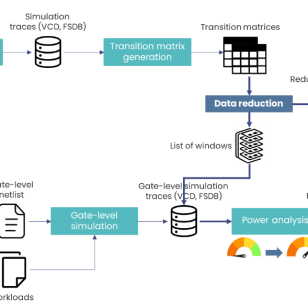
In this research, we proposed an AI-assisted methodology to significantly speed up power consumption modeling. Clustering techniques are used to select representative windows, automatically reducing register transfer level (RTL) traces.
Read more
In cybersecurity, newly-introduced software vulnerabilities must be detected immediately. The generic incremental analysis techniques recently integrated into Frama-C can verify code quickly after local modifications.
Read more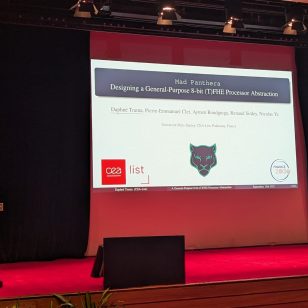
In fields like defense, industry, healthcare, and finance, data privacy is a major challenge. One promising avenue is using fullyhomomorphic encryption (FHE) to compute on encrypted data. However, to implement this approach, many hurdles must be overcome—ones that CEA-List has been working on for years.
Read more
With the development of quantum computers—and their threat to modern cryptography—post-quantum cryptography is gradually making inroads into the industrial ecosystem. HQC (Hamming Quasi-Cyclic) is one of the post-quantum encryption algorithms recently standardized by NIST.
Read more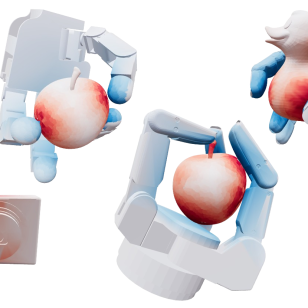
In robotic gripping, the positions of the effectors (phalanges or fingertips) on an object must be controlled precisely. CEA-List looked at a practical case where the only information available was a 3D point cloud of the gripper, generated by visual sensors, simulations, or generative neural networks.
Read more