

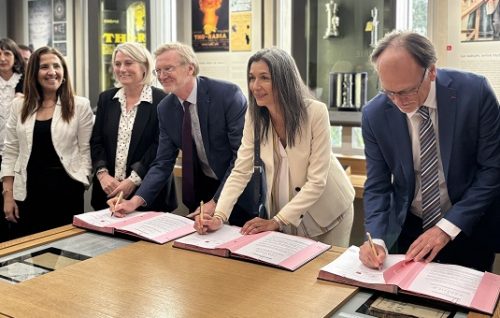
We are pleased to continue the FRATHEA adventure alongside Thales in order to give life to an unprecedented French platform, located in the heart of a unique medical and scientific environment in Europe. As the first proton therapy center in France and the inventor of FLASH radiotherapy, Institut Curie is now preparing to develop a French and European FLASH-VHEE therapy sector, sovereign on a global scale, with a clear ambition: to build a world without incurable cancers.
This partnership will make it possible to have a unique, world-leading platform by 2029 to demonstrate the effectiveness and safety of FLASH-VHEE radiotherapy, and launch the first clinical trials in patients with cancers with a particularly unfavorable prognosis.
Funded by France 2030 and the Ile-de-France Region to the tune of €37 million2 over four years, this pioneering project aims to shorten treatments. It specifically targets cancers located near vital organs or cancers that are difficult to access, such as lung and pancreatic cancers, brain tumors, and pediatric cancers.
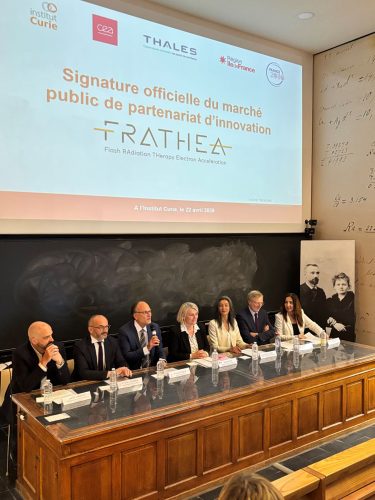
Thales relies on 50 years of experience around particle accelerators, for scientific and sovereign applications, particularly in cooperation with the CEA. Thales is proud to put its technological, human and industrial know-how at the service of Institut Curie's researchers. Within less than three years, the Group will install a high-energy Flash irradiator, the only one of its kind in the world. The exceptional level of mobilization demonstrated by the teams meets the highly demanding technical expectations of Flash radiotherapy research.
The CEA is proud to bring its expertise in radiation protection, particle physics and innovative technologies to the FRATHEA project. Together with Institut Curie and Thales, we are contributing to the design and development of a unique platform in the world, opening new perspectives for the most complex cancers. This partnership illustrates our commitment to accelerating technological innovation at the service of oncology, while guaranteeing the highest standards of safety and performance for patients.
By supporting the most innovative projects, from research to marketing, and by investing in structuring devices such as the "Great Innovation Venues", real collaborative ecosystems, the Ile-de-France Region accelerates the emergence of tomorrow's solutions. Thus, we make innovation in health a strategic lever for health sovereignty, economic competitiveness, and care pathway enhancement. This is the whole point of the FRATHEA project, funded by the Region to the tune of 2 million euros.
ThalesThales, world leader in high technology, has been selected to ensure the construction, assembly and installation of the FLASH-VHEE irradiator on the Orsay historical site of Institut Curie by 2027, following a call for tenders launched in 2025. The ultra-advanced FRATHEA equipment will be installed in a bunker currently being built at the heart of the proton therapy center. These facilities, carried out in collaboration with CEA teams, will bring together the technical and regulatory conditions required for the installation of the irradiator, particularly in terms of safety.
The preclinical implementation of these very high-energy electron beams, of unprecedented intensity and speed, poses important technological challenges.
In collaboration with the Thales teams, the researchers and clinicians of Institut Curie will deploy a two-year action plan that meets rigorous specifications:
Simultaneously, teams from Institut Curie and the CEA are already conducting work in dosimetry, physics, radiation protection, and radiobiology to prepare future FLASH-VHEE treatment regimens. These research are accompanied by simulations, as well as the development of innovative instrumentation and sensors, particularly an ambient dosimetry probe, capable of measuring very high intensity and ultra-fast beams, essential for mastering this technology.
Additionally, the CEA is conducting work on beam monitoring to characterize its shape and calibrate the delivered dose. New preclinical studies* have confirmed the effectiveness of FLASH irradiation on tumor samples. Once the irradiator is installed and approved, the next phase will consist in validating these results. At the same time, the necessary regulatory steps will be taken to demonstrate the safety and effectiveness of the technology, prior to the launch of clinical trials in patients.
*Sparing effects of FLASH irradiation in patient-derived lung tissue, Dubail M. et al., Radiotherapy and Oncology, 2025, https://doi.org/10.1016/j.radonc.2025.111126
Over the past year, the teams have been implementing this major project, and today we have reached a new milestone alongside the Thales teams, mobilizing all our skills to achieve a technological feat: invent state-of-the-art instrumentation, understand the physical and biological phenomena induced by the FLASH effect and utilize them to the best of our ability. This progress will pave the way towards the treatment of the most at-risk and most difficult-to-access cancers.
Once the FRATHEA project is completed, Institut Curie will have an experimental platform open to various academic or private partners. It will bring together state-of-the-art equipment, biological models and technological tools in order to accelerate the development phases and clinical trials for all types of oncology treatments. Lung cancer, pancreatic cancer, brain tumors, pediatric, re-irradiation: the first therapeutic targets for FLASH-VHEE will be cancers for which no or little therapeutic progress has been observed for several years.
The progress of the FRATHEA project reflects the innovation dynamic of Institut Curie, particularly in radiotherapy, a field for which we are currently deploying an investment strategy of €56 million over six years. New horizons and immense hope are opening up for the treatment of thousands of patients suffering from hard-to-treat cancers.
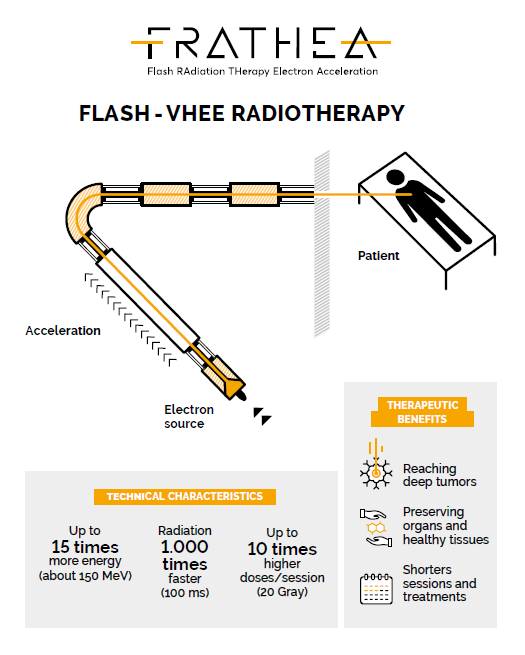
It was in 2014, in the laboratories of Institut Curie, that Dr. Vincent Favaudon discovered the FLASH effect: very intense rays delivered in less than a second destroy tumor cells and spare healthy tissues. Current techniques, based on the use of low-energy electrons or protons, demonstrate high efficacy for skin treatments but do not reach deep-seated tumors.
To overcome this technological barrier, Institut Curie bet on combining FLASH with very high-energy electron (VHEE) radiotherapy. These VHEE beams, with an energy range of 100 to 200 mega-electronvolts (MeV) compared to just 10 MeV in conventional radiotherapy, offer significant physical and biological advantages for treating deep-seated tumors.
Learn more: FRATHEA: the new era of FLASH radiotherapy opens up at Institut Curie