Papyrus is an open-source model-based system engineering platform that facilitates the design of complex hardware and software systems. It is based on the international modeling standard UML.
Now it exists in two versions: a historical desktop version and, since 2026, a web version, both licensed under Eclipse.
Papyrus is a platform for assisting in the design of engineering projects. It enables a hardware and software system – initially described in natural language through its specifications, requirements or technical specifications – to be represented visually as a set of coherent views of the system. This model, representing the architecture and behavior of systems, is a proven method for managing their complexity.
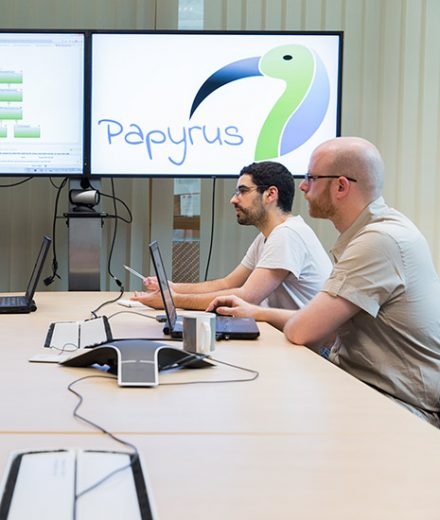
Like Papyrus-Desktop, Papyrus-Web is a UML-compliant modeler, supporting the concept of profiles and designed to be extensible, configurable and adaptable to meet the business needs.
The main difference? Papyrus-web requires no installation. It runs on a server available from any web browser, making it easier to use.
The key feature? Papyrus-Web is a true collaborative tool, allowing multiple users to work simultaneously on the same model. Whether teams are spread across different locations or working side-by-side, everyone remains synchronized, with changes instantly visible to all stakeholders.
Papyrus-Web can be tested online at this address: papyrus-web.fr
It generates models compatible with standard languages UML (Unified Modelling Language) and SysML 1.6 (Systems Modelling Language), which makes it interoperable with other tools being part of an engineering chain. Papyrus also has features that make it easy to adapt to different domains or specific types of systems—software, electronic architectures, robots, manufacturing processes, logistics flows—and projects.
Several Papyrus extensions enable the analysis of the target system before it is built and the automatic production of documentation and software code:
Papyrus is part of the Eclipse open-source development environment.
Papyrus offers a number of major advantages:
System modeling: Papyrus can model all or part of a system (requirements, functional architecture, software architecture, etc.) in standard languages UML and SysML 1.6, or in any specific modelling language. The platform can be configured for a specific domain, and specific methods can be implemented to meet the user’s needs. Diagrams, text, tables, and other editing tools are used to create a description of the model from multiple viewpoints, an approach typical of model-based approaches.
Decision support: Papyrus simulation, constraint verification, and other services can be used to generate qualitative and quantitative indicators from a system model to inform the decision to pursue a particular system build or update or not. Models are usually produced directly by Papyrus, but they can also be imported or generated from existing data.
CEA-List and partner Systerel developed a Papyrus module for the functional modelling of signaling systems for the rail industry. The development work was done for France’s national rail infrastructure operator SNCF Réseau as part of the ARGOS signaling system digitization project.
The rail signaling modelling tool, called AMS, has all of the features needed to model and instantiate a signal box. SNCF Réseau can use the module to:
Learn more in this article

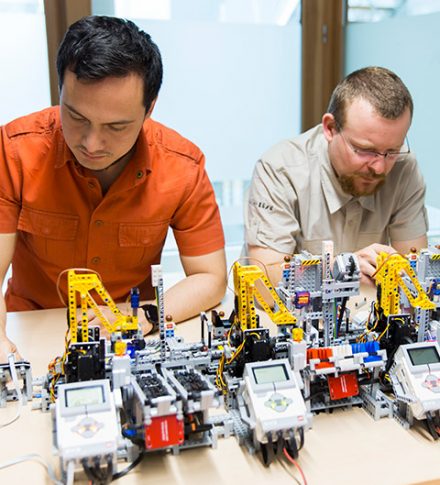
Papyrus was specialized for the modelling, simulation and optimization of manufacturing and logistics processes. It was initially specialized in partnership with ALSOLENTECH to respond to the company’s need for solar farm deployment modeling and simulation methods capable of factoring in unpredictability. Since then, the software has been used for instance to detect conflicts between assembly line activities (FactoryLab GECO project; Stellantis use case, see the news); to model and automate the deployment of digital interfaces between components and applications inside factories (CanvAAS EITManufacturing project); and to dimension a logistics service (Digilogs project with the company Log’s, see use case).
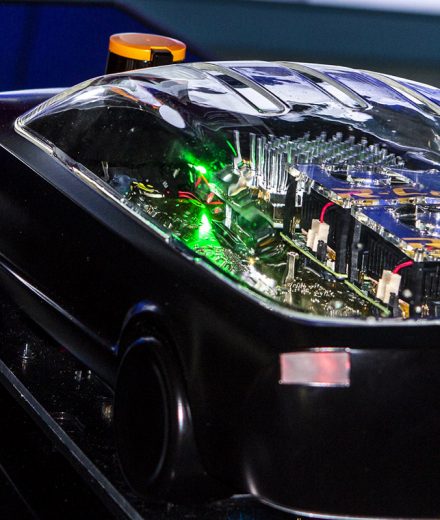
As cars become more connected and autonomous, the amount of technology inside them (from sensors to computers) is growing exponentially, creating some unique integration challenges. During the FACE project, CEA-List, in partnership with the Renault-Nissan-Mitsubishi Alliance, developed a specialization of Papyrus to automatically verify system runtime configuration and compliance after new functions are added. The results are leveraged in Alkalee startup, which also targets other companies in the transportation, defense, and autonomous systems industries.

These Papyrus use-cases are part of the functional digital twin, which helps decision-making when facing complex business processes. Based on digital representations and appropriate analysis means, a functional digital twin is made to virtually reproducing a system’s organisational dynamics. The aim is a safe—since digital—evaluation of possible evolutions of the system; the raise of an alarm in the eventuality of a risk; an help to dimension required adaptations.
Learn more about Papyrus: