
Share

Toward smart acquisition systems

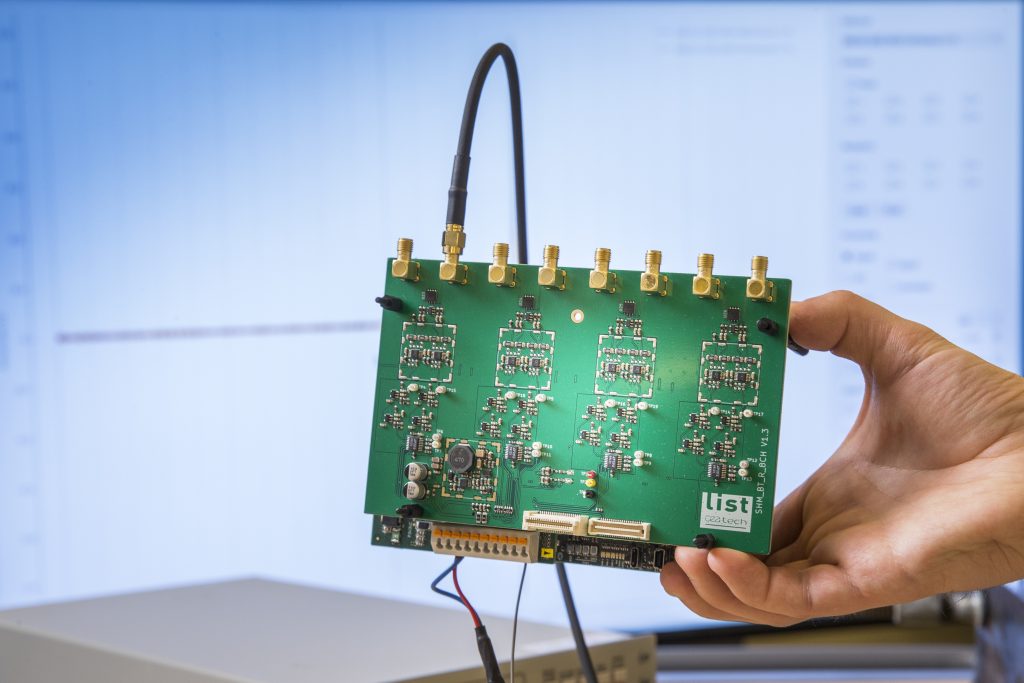
Analog acquisition circuit board integrated into the GERONIMO system. credit : Cyrille DUPONT / The Pulses – www.thepulses.com
Advances in Edge computing and AI have made integrating analysis capabilities directly into acquisition systems a reality. These technologies can aid with non-destructive testing (NDT) and, if structures are instrumented with sensors, automate structural health monitoring (SHM).

Smart acquisition systems are the way of the future. However, what these systems will look like will depend on the use case. For non-destructive testing, for example, the purpose of these systems is to guide inspection and provide decision-assistance to support human operators. In structural health monitoring, sensors generate a continuous and very large stream of data. The automated in-sensor analysis of this data would limit the amount of data exchanged-overcoming a major challenge. At CEA-List, we possess broad, deep knowledge of the hardware used in acquisition systems and have the capacity to integrate AI models and processing directly into sensors. For example, our Aidge framework was developed to manipulate, convert, and optimize neural networks for Edge devices, while our GERONIMO acquisition system for guided-wave measurement enables the deployment of end-to-end solutions, from sensor to diagnosis. CEA-List has developed two proof-of-concept prototypes that illustrate these capabilities. Smart acquisition systems are the way of the future. However, what these systems will look like will depend on the use case. For non-destructive testing, for example, the purpose of these systems is to guide inspection and provide decision-assistance to support human operators. In structural health monitoring, sensors generate a continuous and very large stream of data. The automated in-sensor analysis of this data would limit the amount of data exchanged-overcoming a major challenge. At CEA-List, we possess broad, deep knowledge of the hardware used in acquisition systems and have the capacity to integrate AI models and processing directly into sensors. For example, our Aidge framework was developed to manipulate, convert, and optimize neural networks for Edge devices, while our GERONIMO acquisition system for guided-wave measurement enables the deployment of end-to-end solutions, from sensor to diagnosis. CEA-List has developed two proof-of-concept prototypes that illustrate these capabilities.

First, a ConvNeXt-type model, reduced for constrained hardware environments, was implemented on TFM image analysis for ultrasonic weld inspection[1]. The model, trained on experimental data, classifies images with no false negatives—a non-negotiable in industrial environments— and identifies 87% of healthy data under nominal inspection conditions. To ensure the model is robust, we modified the inspection conditions by moving the probes during inspection and by changing the geometry (pipes, plates, variations in thickness) of the structure inspected. We used Aidge to optimize the model, which was then efficiently deployed on a NXP i.MX8 architecture (Figure 1), the foundation of our different acquisition systems.
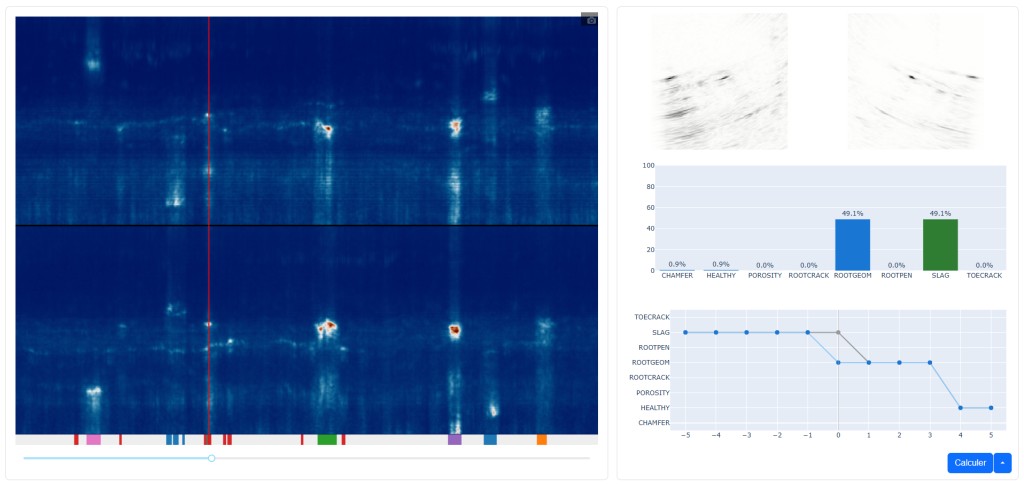
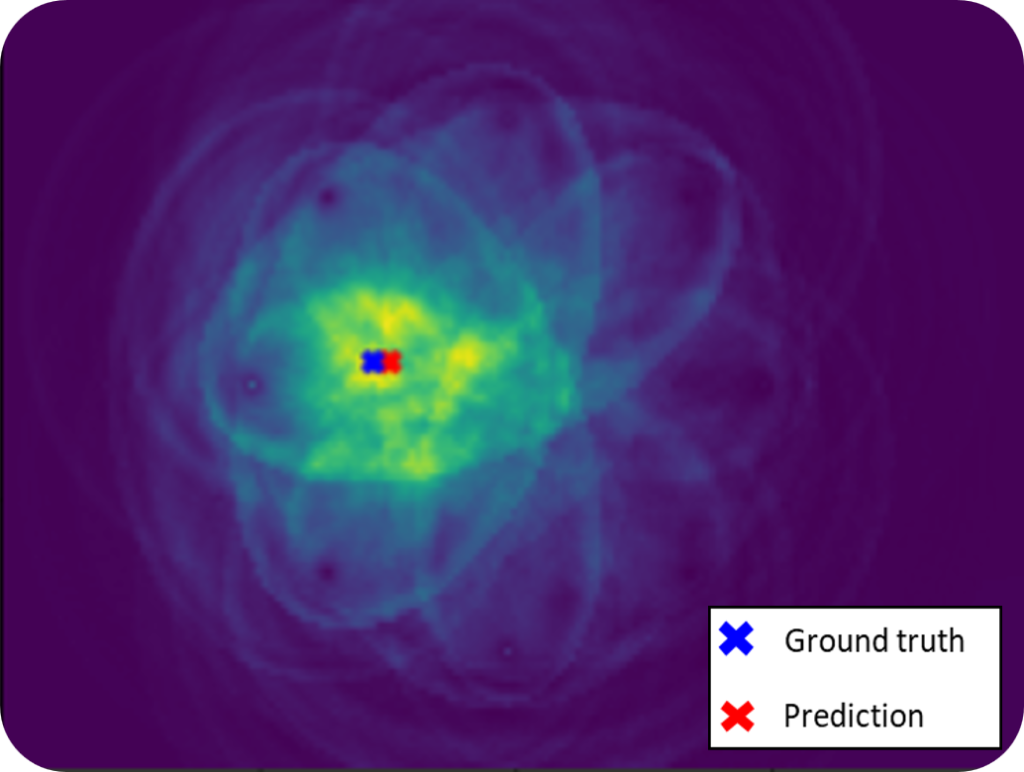


Figure 1 : Left: complete inspection of a weld using the two probes (top view).
Right: TFM images from both probes, results of the current prediction, and a
comparison of the predictions with the expert reference.


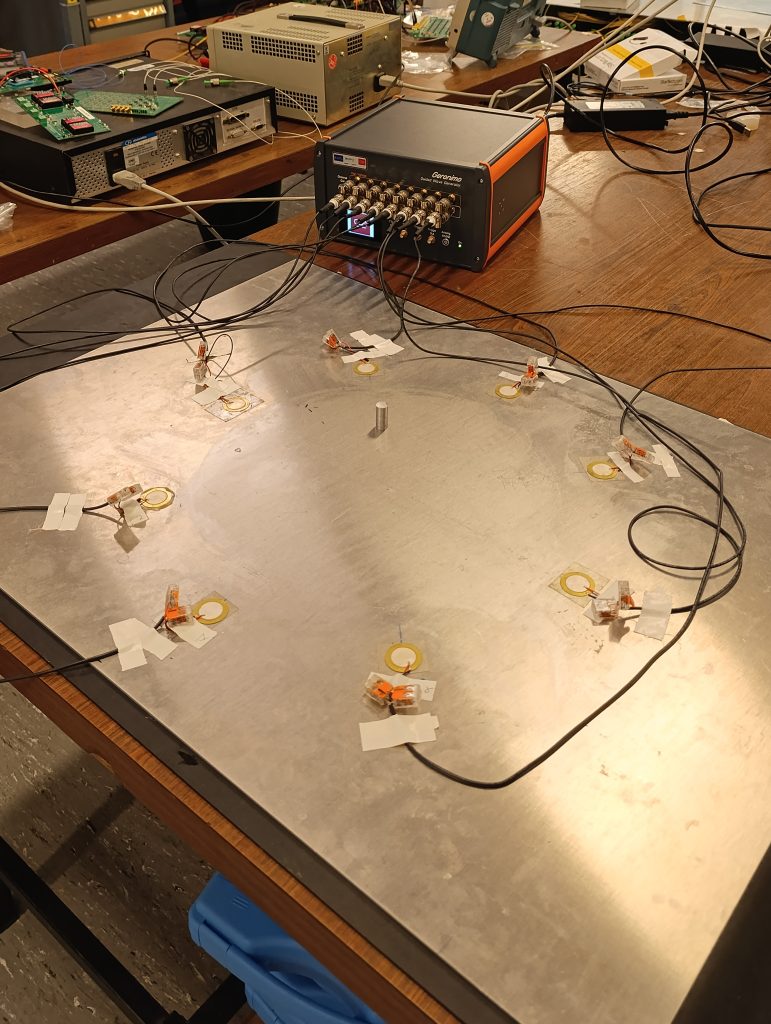
A frequency of around 10 Hz was achieved during inference. In guided-wave structural health monitoring[2], the goal is to automate the entire chain, from acquisition to decision-making. In this demonstration, we used an image-processing convolutional neural network for delay-and-sum (DAS, Figure 2) image analysis. This qualitative imaging method is not the most efficient in terms of resolution, but it is still widely used at the state of the art and, therefore, remains a relevant test case. Data simulated with CIVA software was used to train the model, which was then adjusted by transfer learning on a few experimental measurements, enabling defects to be located and measured. The model, converted using Aidge and embedded in the GERONIMO acquisition system (Figure 3), reduces the volume of sensor data from several kilobytes to just three floating values. This compression considerably reduces data transmission, enabling continuous monitoring, even on heavily instrumented structures.


Figure 2: DAS imaging with the model’s prediction of the defect’s position.

Figure 3: Plate instrumented with the GERONIMO system.


We are now working to expand the range of processing methods available to include guided-wave tomography. We are also integrating AI into GERONIMO and its OPTOGERO version for fiber Bragg grating measurement[sup>[3].

Key figure

÷10000

Embedded data compression: up to 10,000x less data (3 floating values instead of several kB of data)

Embedded guided-wave analysis transforms measurement data into clear indicators of the structure’s condition, enabling continuous monitoring.

Robin Guyon

Research Engineer — CEA-List

Learn more

Use cases, applications, technology transfer

  • GERONIMO : Partnership with UGE and licensing agreement with Capturia for commercialization.

Major project and/or partnership

  • Find, Renaissance Fusion, Alstom RSHM, DeepGreen, Multimod’AIR, etc.

Flagship publications

  • [1] « Embedded Artificial Intelligence in Guided Wave SHM system: Signal processing, and data analysis ». C. Fisher, A. Recoquillay, B. Chapuis, and P. Calmon, e-Journal of Nondestructive Testing, vol. 30, no. 06, Jun. 2025, https://doi.org/10.58286/31305
  • [2] « Towards embedded AI models for welding defect detection in pipes » R. Guyon, M. Newson, C. Fisher, R. Miorelli, and D. Roué, in 2025 IEEE Sensors Applications Symposium (SAS), Jul. 2025, pp. 1–6, https://doi.org/10.1109/SAS65169.2025.11105144
  • [3] « Embedded passive guided wave tomography. Application to corrosion monitoring in multilayered pipes » A. Recoquillay et al., e-Journal of Nondestructive Testing, vol. 29, no. 07, Jul. 2024, https://dx.doi.org/10.58286/29855


Contributors to this article:

  • Clément Fisher, Research Engineer, CEA-List
  • Robin Guyon, Research Engineer, CEA-List