
At a time when we are already looking ahead to Industry 5.0, with its focus on people, sustainability, and resilience in production, many of the challenges of Industry 4.0 remain unresolved. One of them is order-driven production. To satisfy a wide variety of orders—whether in terms of number of units or type of product—order-driven production lines must be extremely flexible and automated.
This requires three key capabilities: monitoring production asset availability; dynamically assigning production operations to the assets; and automatically integrating new assets into the existing production process.
Today’s standards and concepts only partially provide these capabilities.
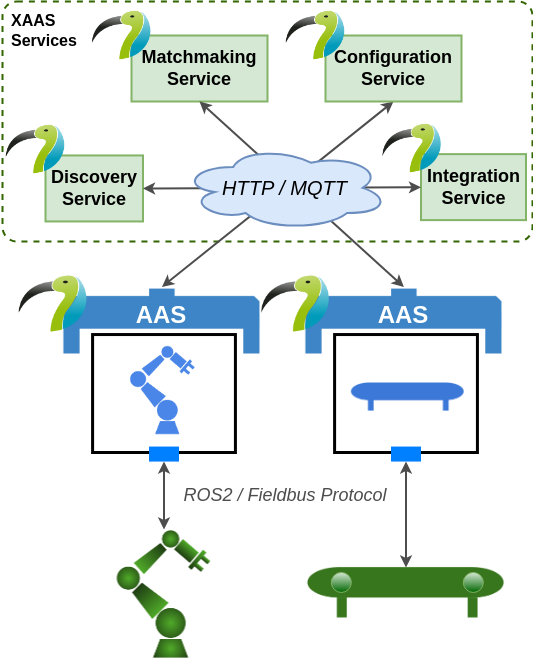
However, AAS presents certain limitations that prevent it from fully integrating CSS and PnP. For example, AAS cannot detect new assets or provide detailed descriptions of asset capabilities.
CEA-List used its Papyrus4Manufacturing platform, with its AAS-standard Digital Twin modeling and generation tool, to develop XAAS, an extendible AAS software architecture designed to enable flexible, dynamic production lines (Figure 1).
XAAS extends AAS with two major additions:
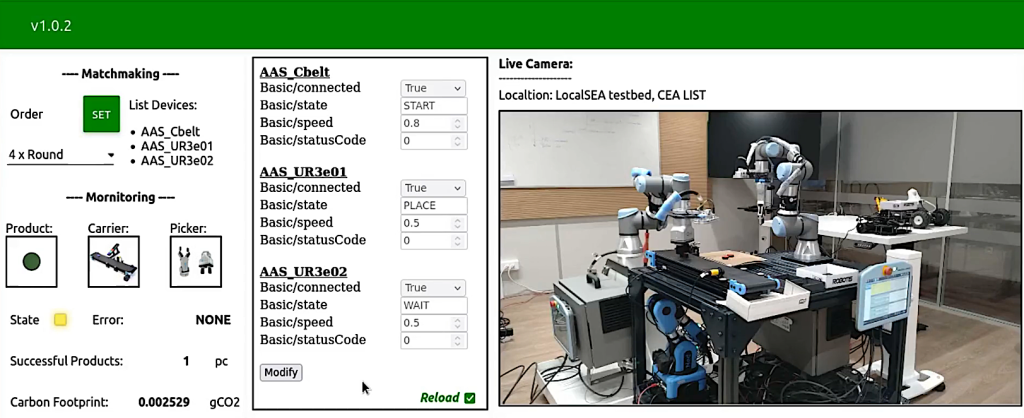
CEA-List implemented the XAAS architecture on a sandbox use case: filling packaging boxes. During the experiment, new assets were automatically integrated into the current production process as soon as they were turned on, and the system correctly assigned tasks to the right robots, confirming the relevance of the XAAS concept.
With XAAS, several asset configurations for a given job can be tested and the best one chosen according to criteria like production time, energy consumption, and the like.
Our Papyrus4Manufacturing modeling platform enables the flexibility and automation that the industry of the future will need.

The INTEROP project has confirmed the potential of our architecture using representative production assets. Building on these results, APS has renewed its partnership with CEA-List.