

The existence of neutrinos was first hypothesized by Wolfgang Pauli in 1930 in a desperate attempt to save the fundamental principle of the conservation of energy in beta decay, in which it appeared that energy was lost. It turned out that neutrinos do exist, but their interaction with matter is extremely limited. Studying neutrinos requires very large detection systems like the IceCube Neutrino Observatory in Antarctica, with its cubic kilometer of ice. Today, still, neutrinos’ properties remain mysterious. While the Standard Model of particle physics predicts neutrino masses to be zero, oscillation experiments have shown that they do indeed have mass. Three
types of neutrinos are currently known, and the existence of a fourth, the sterile neutrino, coupled only to gravity, is still merely hypothetical.
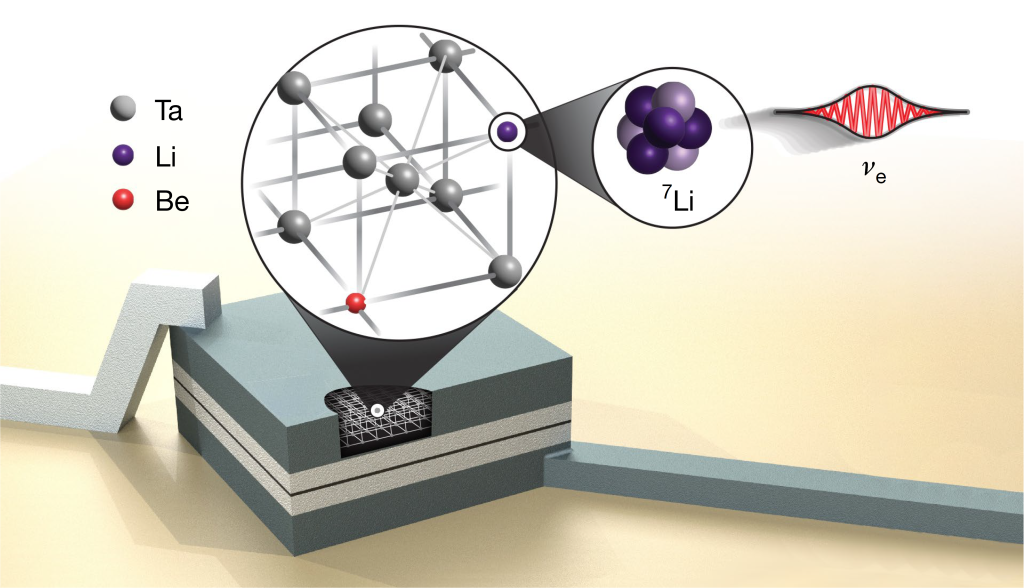
The BeEST consortium, led by Kyle G. Leach, was created in 2020 to study neutrinos. LHNB has been involved in the project since its inception, contributing to an innovative “tabletop” experiment to measure the properties of neutrinos indirectly using extremely small sensors (about
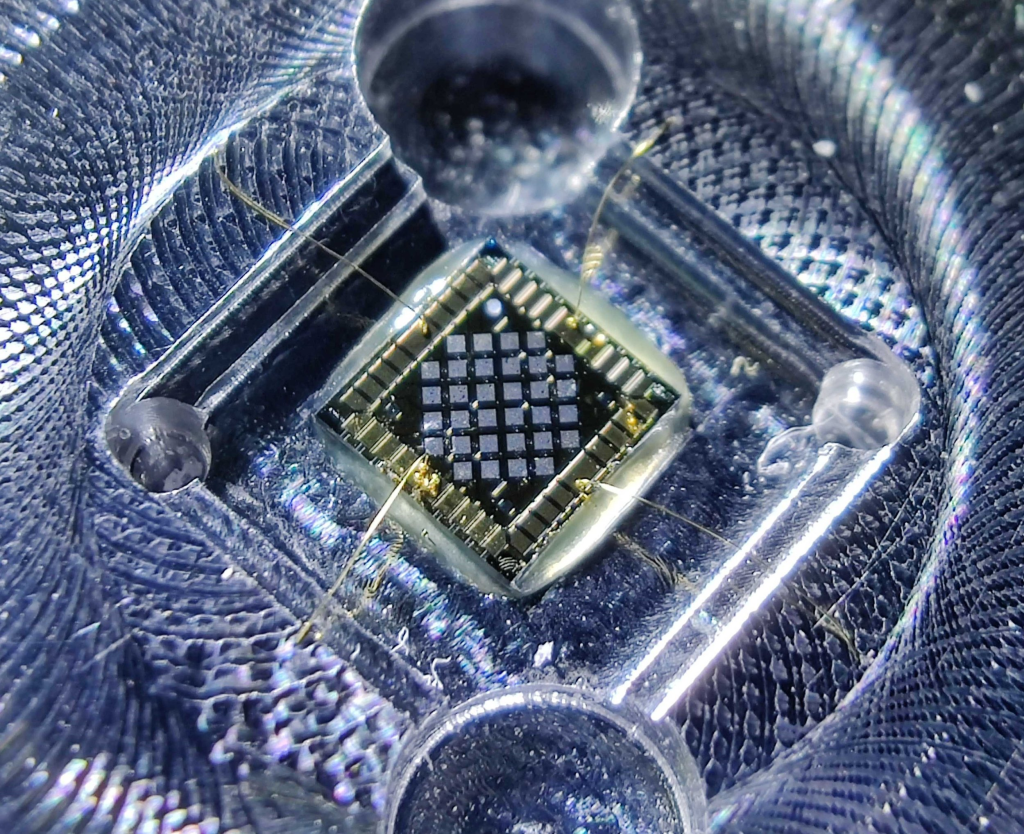
the diameter of a human hair). The radioactive beryllium-7 nucleus, which decays by capturing an atomic electron, is implanted in a superconducting tunnel junction—a quantum sensor with exceptionally high energy resolution. The ultra-precise measurement of the nucleus’ recoil energy—a spectrum of just a hundred electronvolts—provides information about the neutrino emitted, as the two particles are quantum-entangled.
Neutrinos, like any quantum particle, cannot be specifically located. However, there is a probability that one will be present in a certain area of space. Until now, this probability was assumed to correspond to the size of the neutrino’s nucleus. The BeEST experiment yielded a very unexpected observation: As soon as the neutrino is created, it extends over an area thousands of times larger than the nucleus. This finding upends everything
we thought we knew about radioactive decay.
«The BeEST experiment provided a new perspective that has broadened our understanding of radioactive decay.»