

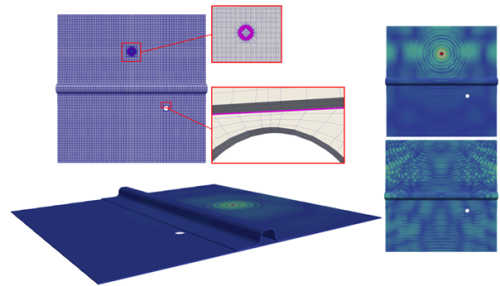
The presence of high-contrast inclusions, thin layers, or highly deformed mesh creates challenges when using standard time-discretization algorithms for the simulation of viscoelastic wave propagation in non-destructive testing (NDT). These features push conventional algorithms to their limits in terms of the maximum time step allowed to ensure correct numerical calculation. The spectral radius of the rigidity operators defined in the «disturbed» area is largely to blame for these standard algorithms’ extremely low time steps and disproportionately high computational costs.
We developed and analyzed two numerical strategies for decoupling the overall stability of the time-discretization algorithm from the local rigidity in the «disturbed» zone.
In our first strategy, locally implicit (LI) schemes, formulated by applying an implicit scheme only for local operators, were extended to viscoelastic models. We used an energy method, independent of the operators restricted to the “disturbed” area, to prove the stability of the final algorithm. This strategy was demonstrated on the three viscoelasticity models most commonly used in NDT: Maxwell, Zener, and Kelvin-Voigt. Stability remains governed solely by the background domain–a significant improvement over the explicit reference scheme.
In our second strategy, we extended the explicit scheme stabilization procedure, coupled with a domain decomposition method, to viscoelastic models. In the «disturbed» area, the steep term is replaced by a stabilizing Chebyshev polynomial, the order of which increases the permissible time step proportionally. In practical terms, this is still an explicit method, but one that requires only local resolution at the interface. An improved, controllable stability condition is established by proven energy decay.
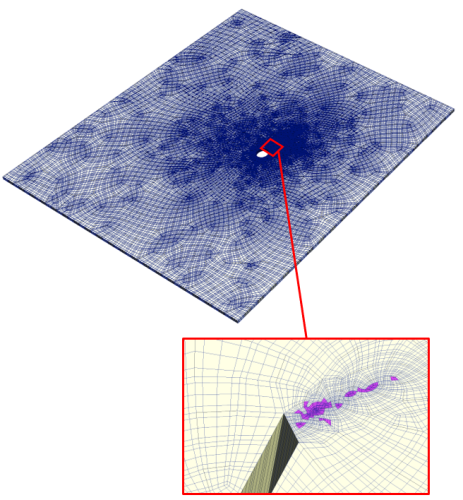
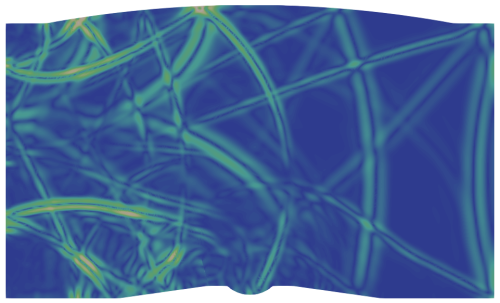
Execution time an order of magnitude less than standard approaches for simulating certain 2D/3D ultrasonic inspection configurations.
We demonstrated that the limitations of some of the numerical algorithms in our CIVA software when complex geometries and/or materials are involved can be overcome
These methods are a major extension of advanced time-discretization techniques for viscoelastic wave propagation models.