

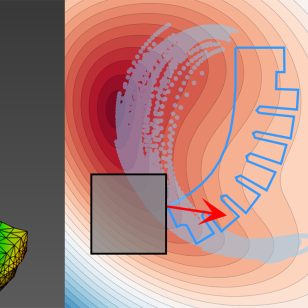
LEBNN, developed by CEA-List, is a neural network architecture for the mechanics of statically hyperelastic structures.
Read more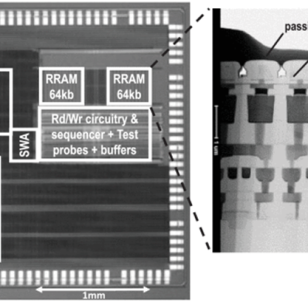
The CEA has been conducting R&D on resistive memory (ReRAM)— an alternative to flash memory—for more than a decade. A complete system integrating ReRAM into a processor architecture was recently designed and validated for advanced memory company Weebit Nano.
Read more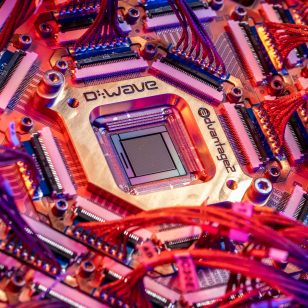
Much like classical application-specific processors, quantum processing units (QPUs) are expected to be used to speed up certain computational steps in algorithm execution.
Read more
Advances in quantum computing are creating new challenges to our current code validation practices. CEA-List is developing new formal-analysis-based verification techniques to respond to this new context.
Read more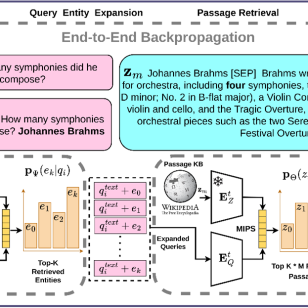
CEA-List developed the MiRAG model for visual question answering about named entities. This is the first time a retrieval augmented generation (RAG)-based approach to generative AI has been applied to this task.
Read more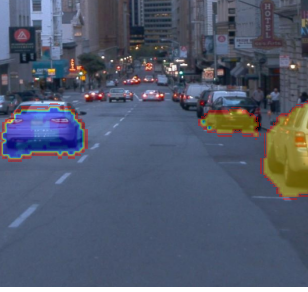
xMOD combines 2D vision (cameras) and 3D vision (LiDAR sensors) in a novel cross-distillation method. The AI learns to segment its environment from motion cues in the images, delivering beyond state-of-the-art performance.
Read more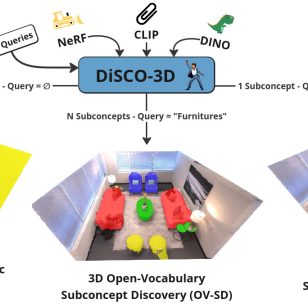
The DiSCO-3D semantic segmentation method is used to discover, in a 3D scene, the elements corresponding to the semantic subconcepts of a user query expressed in natural language.
Read more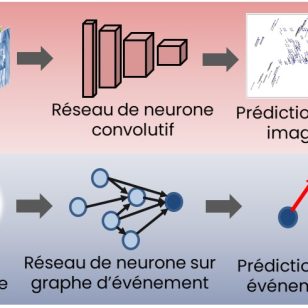
Event-driven cameras provide low-latency motion detection. Our method leverages asynchronous event graphs that take full advantage of the cameras’ high time resolution to detect motion with very low latency (just 50 milliseconds) while reducing the number of operations 48-fold compared to the state of the art.
Read more