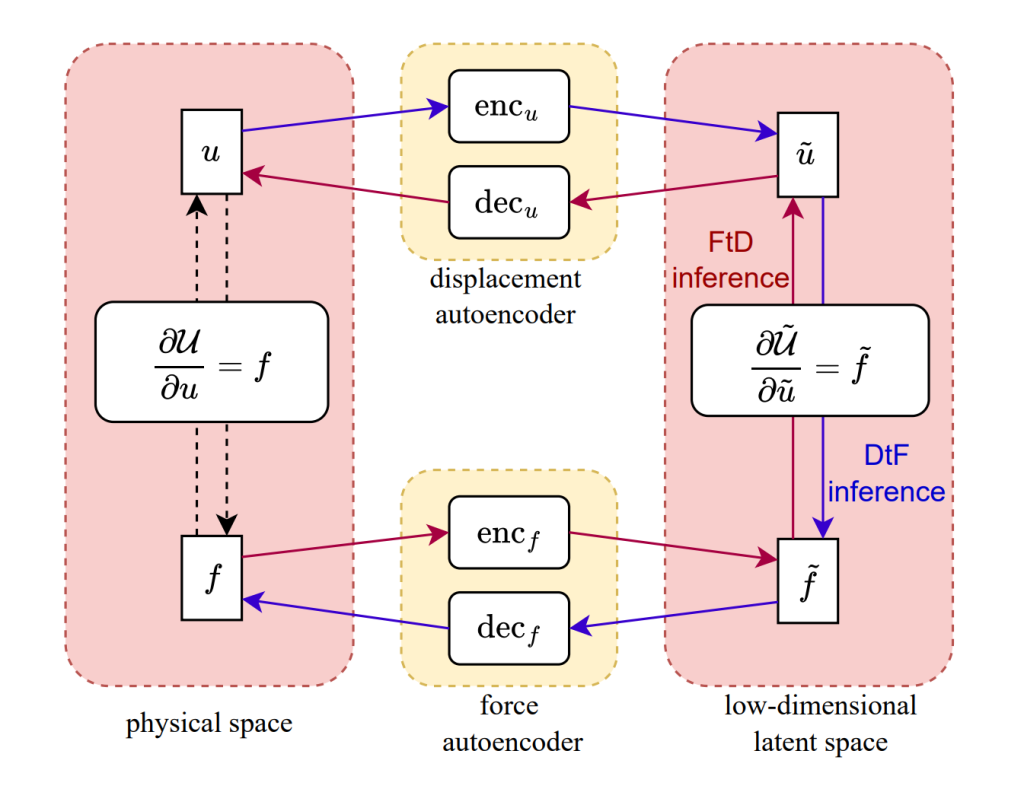

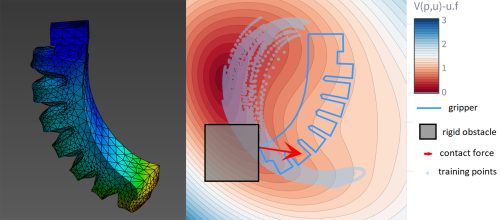
In the statics of non-linear structures, LEBNN solves for the displacement field, u, of a structure subjected to a given force, f. Traditionally, this has been done using the finite element method. When the number of degrees of freedom is large, finite-element solving is too resource-intensive for real-time applications.
Therefore, to speed up the simulation, a dataset of pairs (u, f) can be created and a neural network trained to predict u based on a known f. The goal is to replace the conventional finite-element model.
The traditional approach in the literature u=NN(f) has two major shortcomings:
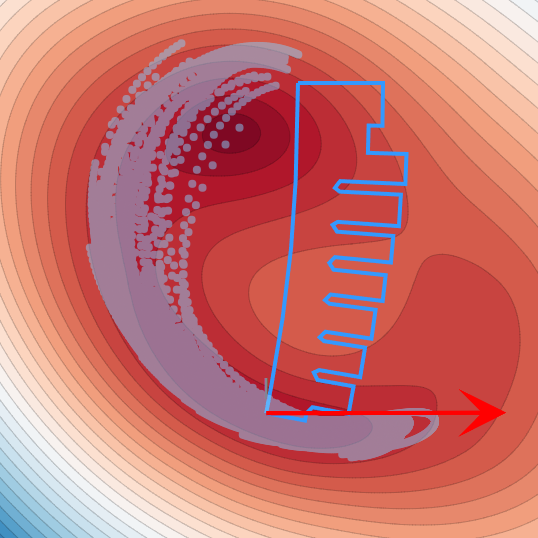
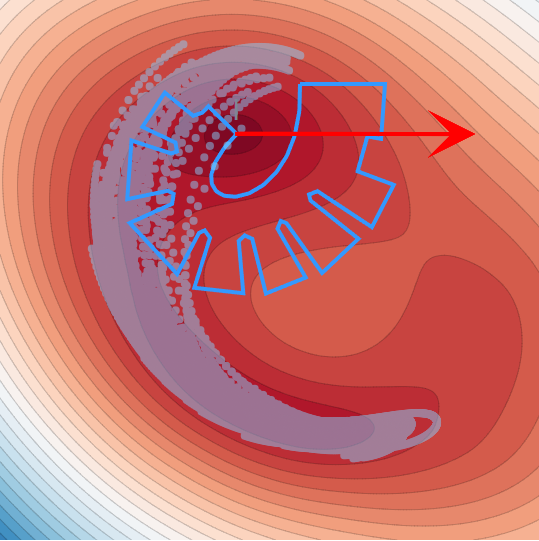
The LEBNN architecture, based on the unsupervised learning of a «latent» deformation energy in a low-dimensional space, solves both problems. Structural properties are encoded in latent deformation energy and, specifically, the topology of this latent deformation energy is the same as the structure’s actual deformation energy, which is generally unknown. The structure’s rigidity matrix can be calculated from the Hessian of the latent energy. After it is trained, LEBNN can be integrated into a multi-physics simulation, totally replacing the learned structure’s finite-element model.
In research for the EU ARISE project, we produced an interactive simulation incorporating a flexible gripper made from hyperelastic materials. Finite-element simulations, which take several minutes, are still a long way from real time. We replaced the gripper’s physical model with a LEBNN trained on a hundred simulations. With an inference time under a tenth of a second, coupling with a real-time contact algorithm is now possible.
This demonstration opens the door to the real-time simulation of a new class of systems.