

Innovations in IoT, AI, virtual reality, and other technologies have positioned Digital Twins as a key technology in recent years. And yet, the deployment of Digital Twins raises crucial questions about their economic viability and environmental sustainability.
Industrial maintenance was the first real-world use case for Digital Twins, and it is where the most mature technologies and implementations are currently found. According to our review of the literature, predictive maintenance—enabled by AI and large volumes of data—is the most common use of Digital Twins today. Recent advances in virtual and augmented reality have generated
significant additional costs in terms of both hardware and software.
Our qualitative methodology was developed to give industrial maintenance Digital Twins a score indicating their economic and environmental costs. The goal is to help decision-makers ask the right questions from the design stage, when quantitative data is often lacking. We also wanted to propose a tool that is more accessible than more comprehensive methods, like the Life Cycle
Assessment (LCA), and that provides a simplified eco-design framework.
Our methodology is based on three key criteria, which, scored on a scale of one to five, determine a Digital Twin’s economic and environmental costs (Figure 1):
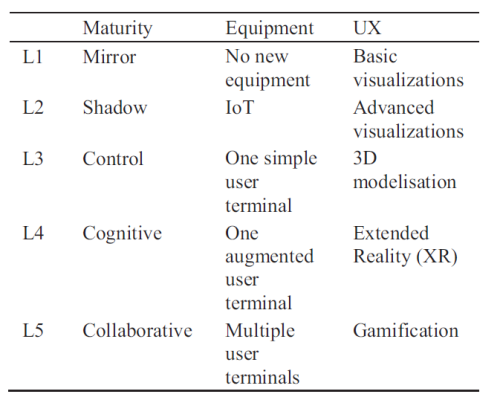
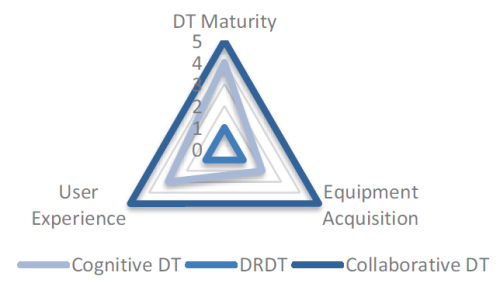
The scores for each of these three criteria are added up to arrive at an overall score. The higher the score, the greater the environmental and economic impacts. We applied our method to three Digital Twins from the literature: a predictive maintenance Digital Twin (Cognitive DT), a collaborative Digital Twin for remote maintenance (Collaborative DT), and a remaining useful life prediction Digital Twin (DRDT). Figure 2 shows the results of the evaluation of these three Digital Twins.
Although our methodology can be used to score various types of Digital Twins, it does have its limitations. For example, data management is not included, and it does not cover the entire lifecycle. Finally, it doesn’t distinguish between economic and environmental costs, which are, in
some cases, contradictory.
In its current form, our methodology does provide an initial understanding of the economic and environmental impacts of Digital Twins. However, additional development will be needed to make the tool more reliable.
of the environmental impacts of digital products and technologies stem from the equipment itself—from IoT devices to computer displays.
This approach helps decision-makers ask the right questions and provides them with a more accessible and faster starting point for eco-design.