

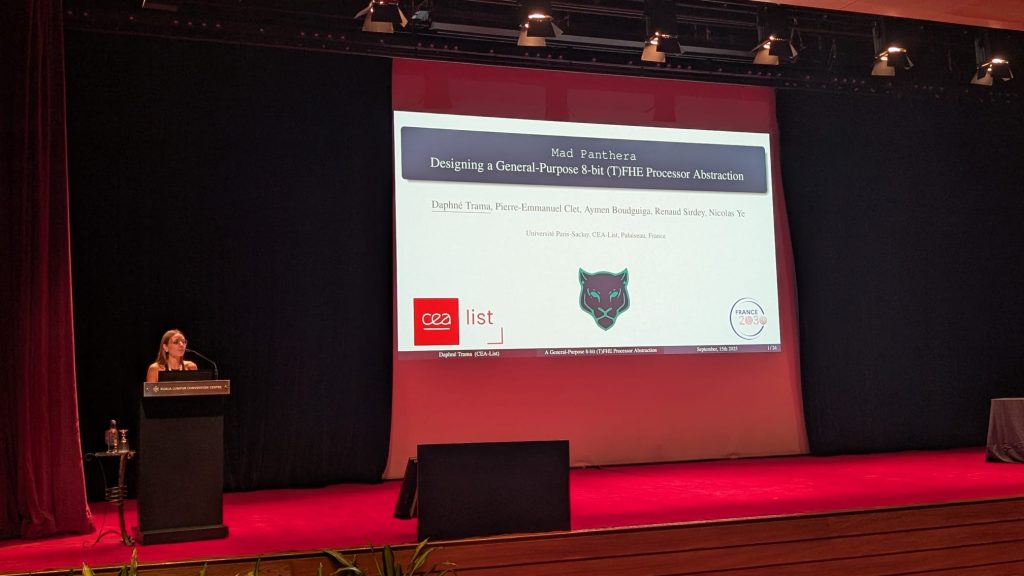
CEA-List had been working on its open-source compiler, Cingulata, since 2015. In 2020, our researchers began looking for a way to give general-purpose FHE a “second wind”. The idea was to transform the promise of running any algorithm in the encrypted domain into a reality while seeking approaches that could exceed the state of the art in terms of potential hardware acceleration.
In 2022, Daphné Trama’s PhD research presented an opportunity to address these issues. The strategy was to create a small corpus of FHE operators based on the TFHE fully-homomorphic encryption scheme to rebuild, from the ground up, a more efficient, beyond-state-of-the-art general-purpose FHE approach. This meant creating a first set of general-purpose instructions for manipulating FHE ciphers for a software abstraction of an 8-bit processor.
We reached a major milestone this year with a solution based on advanced programmable bootstrapping techniques and the TFHE cryptosystem, which CEA-List helped develop in 2016-2017. One of the major challenges faced by the FHE community in recent years has been to gain a deeper understanding of TFHE’s scope and make the best use of its capabilities. To address these challenges, we investigated the use of TFHE bootstrapping with integer ciphers—an approach that remains underexplored for general-purpose FHE and that is competitive with the state of the art. Like Cingulata, this method is based on the evaluation of Boolean circuits on binary ciphers.
Daphné’s team got to work developing a general-purpose homomorphic «processor» with an ISA (instruction set architecture) of around fifty instructions. This universal set of instructions was used to implement the homomorphic equivalent of any classical algorithm (including array sorting, averaging, finding a maximum/minimum, and for the first time, evaluating a neuron with a sigmoid activation function and inputs/outputs to several decimal places of precision). The ISA was used to evaluate a half-dozen algorithms. The results revealed that our approach is, on average, almost twice as efficient as the state of the art, performing particularly well in cases where the Boolean circuit corresponding to the executed instruction grows (typically, a multiplier of 1x is sufficient).
The following table presents an overview of the results, with runtimes expressed in seconds.
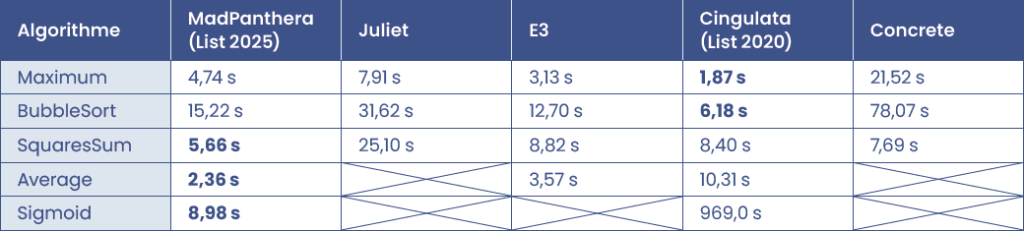
Cingulata, which remains significantly faster than competing solutions, is the most competitive with the state of the art.
It also provided an idea of what the computing kernels to be optimized and/or accelerated for general-purpose FHE might look like. These insights open the door to further joint research with CEA-List’s hardware design experts. In the longer term, this research could even lead to the development of a hardware accelerator specifically for the optimization of this virtual processor.
In connection with this research, we also addressed the homomorphic execution of the AES (Advanced Encryption Standard), a flagship use case at the center of the first NIST (National Institute of Standards and Technology) call for projects on FHE. After improving the international state of the art by a factor of ten in 2023[3], several research teams from different countries have continued to come up with new techniques, setting a series of new «records» for the fastest homomorphic AES execution. In 2025, a partnership with CryptoExperts put France back in the lead in this friendly international competition with a new, more efficient technique that outperformed the previous record by 33%. The improvement was obtained by using MadPanthera’s foundations in conjunction with a complementary method called p-encoding.
Homomorphic computing algorithm runtimes on ciphers cut by half
This research was presented at CHES 2025, a leading conference, and was published[1] in the conference proceedings (IACR Transactions on Cryptographic Hardware and Embedded Systems).