

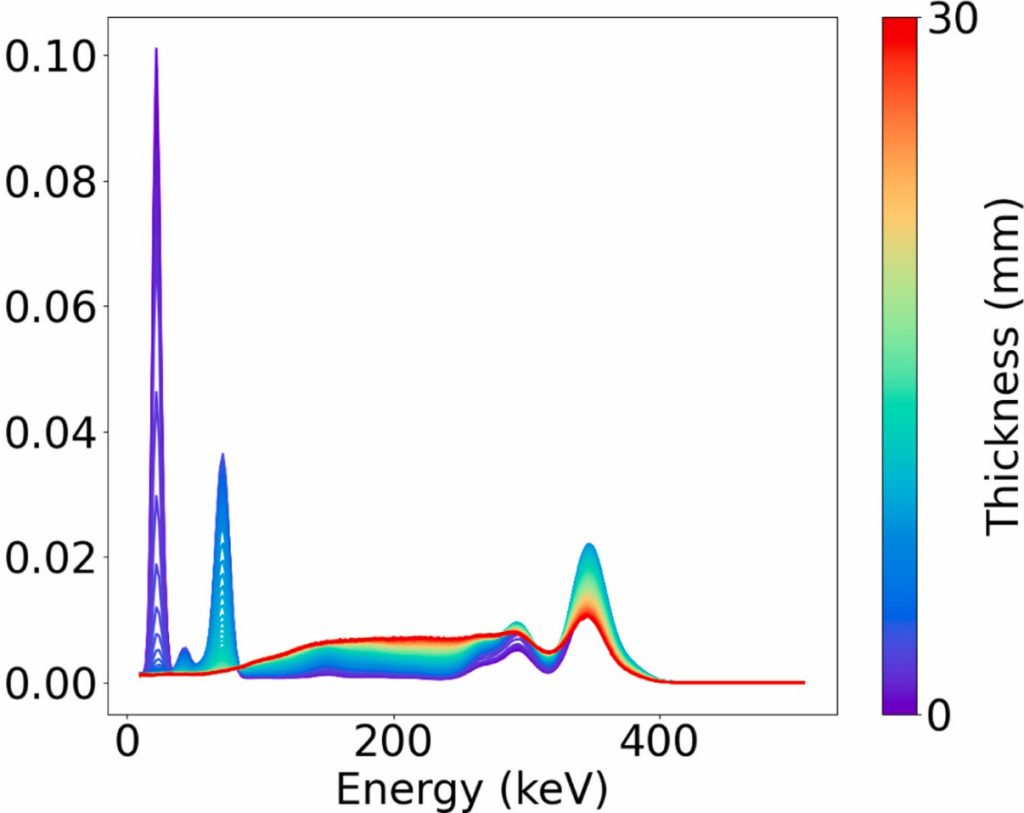
CEA-Leti combined machine learning and statistical techniques in SEMSUN, a hybrid spectral demixing algorithm. An interpolation autoencoder (IAE) was used to learn spectral distortions induced by Compton attenuation and scattering phenomena in the source’s environment. The autoencoder, a neural network, can extract the characteristics of a spectrum in a compressed representation (encoder) and can be used as a generative model to reconstruct the spectra from the learned characteristics (decoder). The spectral unmixing technique is based on a mixing model of spectral signatures specific to each radionuclide present. SEMSUN uses the IAE model to impose a constraint on the deformation of these spectral signatures in solving an inverse problem. This hybrid approach optimizes
radionuclide identification and counting by explicitly integrating the physical characteristics of a measurement, unlike a state-of-the-art approach that relies on end-to-end learning.
The IAE model training was based on Geant4 code simulations of radiation-matter interactions in a geometric configuration in which a point source is placed at the center of a sphere (steel, lead), with a 3“×3“ NaI(Tl) detector (Figure 1). Spectrum reconstruction results show that the IAE model effectively captures spectral deformation, allowing us to establish the proof of concept[1].
To automatically identify radionuclides, SEMSUN was combined with a model selection technique based on a likelihood ratio test, resulting in a new algorithm, MoSeVa[2]. A sparsity criterion was applied to the various
spectral signatures grouped together in a library to determine the presence of a radionuclide. Tests were carried out on different natural background radiation mixtures (up to four radionuclides in a library of twelve spectral signatures). Different counts in the spectra were also studied up to a minimum count of 2,500 events (Figure 2).
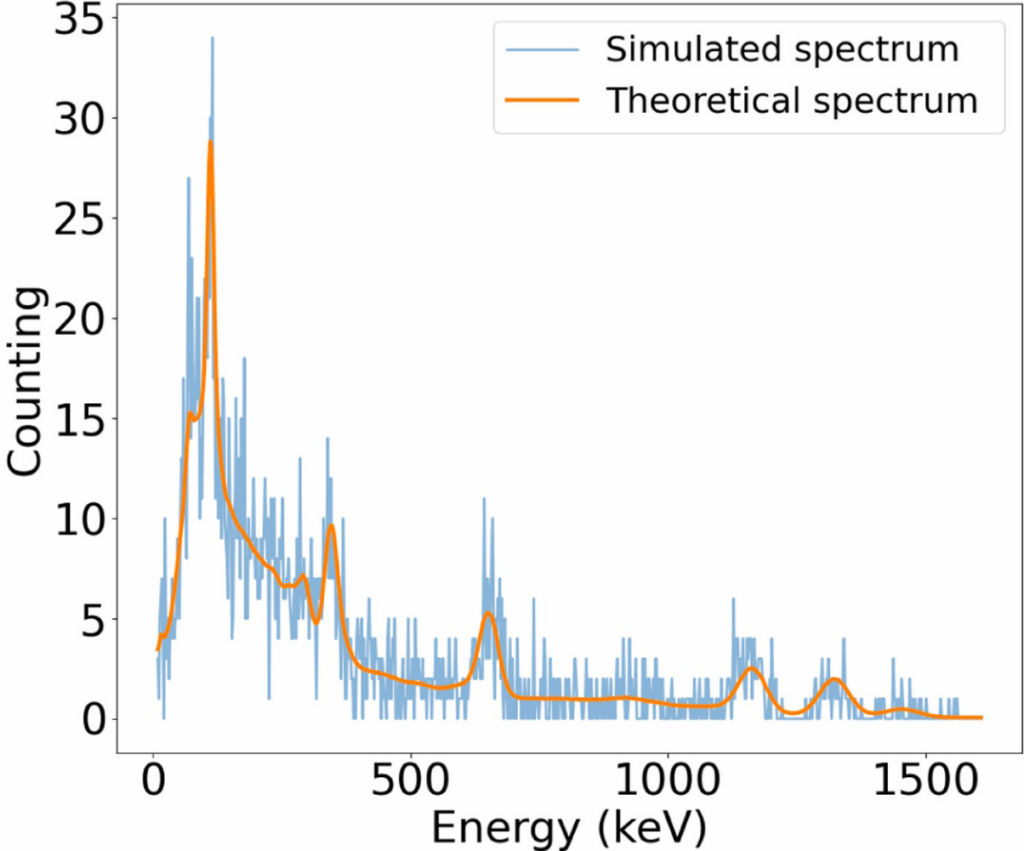
Hybrid spectral unmixing was compared to a state-ofthe- art end-to-end learning method based on convolutional neural networks used as classifiers or for regression applications. The results confirm that hybrid spectral demixing performs better on low-statistics measurements in terms of identification and robustness, with the expected false alert rate. Hybrid spectral demixing also enables more accurate counting beyond low statistics[3]. The GammaBench benchmark (including spectra, evaluation metrics, etc.) can be used to compare the performance of new developments with hybrid spectral demixing.
"Hybrid spectral demixing offers a solution to the problem of low-statistics in situ measurements sensitive to spectral variability.»

Improvement using hybrid
spectral demixing on
quantization compared to
end-to-end methods.