

In the future, intelligent digital systems for autonomous mobility or the Internet of Things (IoT) will require even greater computing power than today. All this whilst meeting an ever-increasing number of non-functional requirements. CEA-List’s Computing and Digital Architecture programme aims to invent new component architectures offering modularity, scalability, security, safety and sustainable design, whilst addressing the challenges these systems face in terms of their intrinsic requirements regarding space, energy consumption and costs.
Digital architecture is a discipline within microelectronics that lies halfway between semiconductor technologies and digital systems. It involves designing the internal layout of the components that make up these systems.
The CEA-List’s Computing and Digital Architecture programme focuses on the computer components that will be found in the autonomous vehicles and connected devices of the future. These embedded systems will need to be equipped with very high computing power to run increasingly sophisticated artificial intelligence applications. However, they will always face significant constraints in terms of size, energy consumption and cost. The aim of the programme is to create new architectures, optimised to address these conflicting challenges.
The research focuses on three areas in particular:
The programme’s teams work in close collaboration with industry partners who, further down the supply chain, manufacture digital systems (component manufacturers and system integrators). The aim is to jointly design digital systems and their architectures.
Research in these three areas also requires close collaboration with the semiconductor sector to make the best use of technological advances (miniaturisation, fine-line circuit etching, layer stacking, etc.). For this reason, the CAN programme teams collaborate closely with those at CEA-Leti as part of a ‘co-optimisation’ approach, i.e. by seeking to optimise circuit architectures and technologies simultaneously.
This research area focuses on the design of new component architectures based on chiplets for embedded systems and high-performance computing. The research includes studies on communication infrastructures between chiplets. CEA-List also contributes to the open hardware community’s work on these topics.
Learn more about architectures for heterogeneous computing.

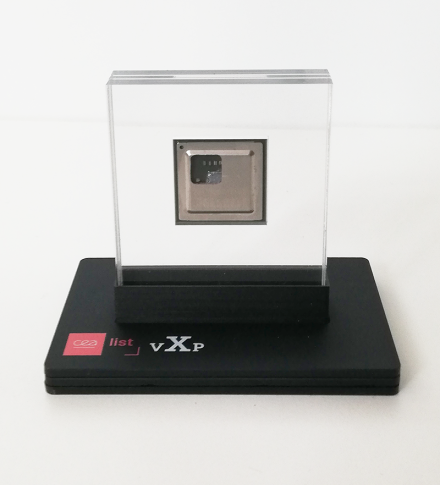
The second research area addresses the growing need for intensive data processing, whether within a computer for AI applications or within an instrumentation chain. It focuses on the design of architectures aimed at overcoming limitations related to data precision and transfer.
Learn more about architectures for data-centred computing.
CEA-List has a comprehensive environment to support the design and validation of models, which facilitates the implementation of proof-of-concept projects. The aim of automating these design processes is to stimulate the market’s adoption of these new-generation, high-performance digital systems.
Learn more about our methodologies and tools for analysis and design.
